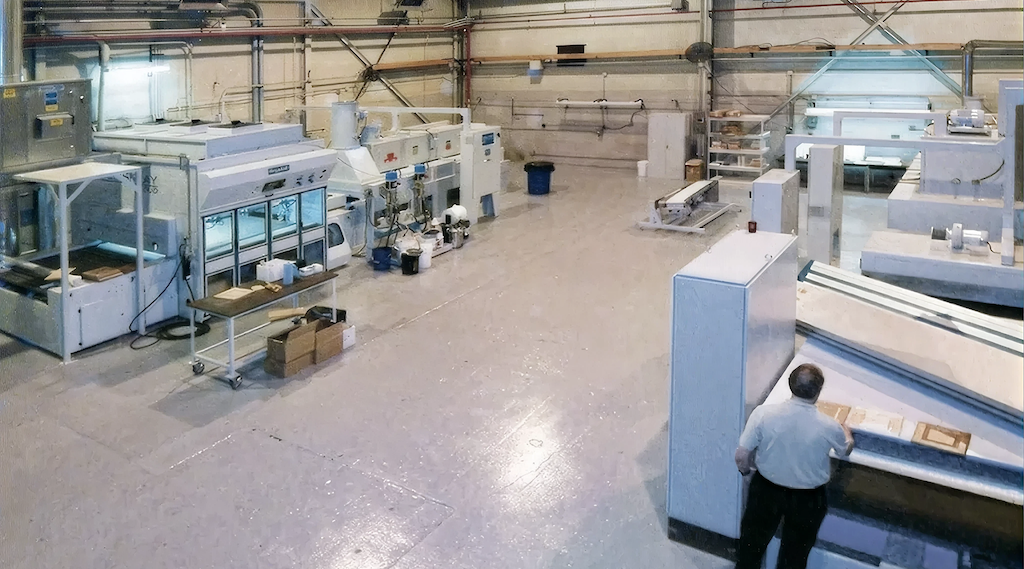


Focus on time robbers
Future-proof coating lines are characterised by cost-effectiveness and maximum flexibility thanks to the use of intelligent control and digitalised communication systems. Venjakob's modular concept also allows the individual machines to be equipped as required and upgraded with additional functions at any time.
Surface coating in the industrial production of plastics components, including for the automotive industry, is an important, possibly even the most important part of the entire production chain. A lot of money can be spent here, but just as much can be saved. Expensive paints, time-consuming machine cleaning, compliance with environmental regulations and constantly changing trends in materials and coats require technical equipment that offers the user the required flexibility and thus investment security over the years.
Overall concept with optimised individual equipment
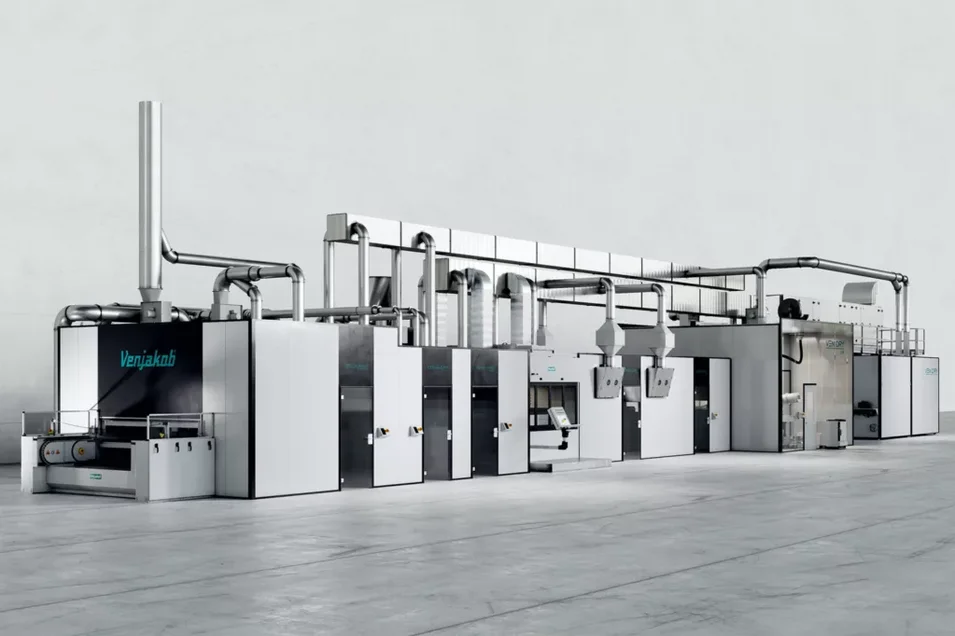
The overall system concept for surface treatment described here serves as an example of what modern coating lines are capable of. Plastics parts are painted and dried in the system using wet paint systems. The individual machines - from pre-treatment to coating and drying - were equipped with optimised individual equipment and combined to form a complete system. Traditional 1K and 2K solvent-based water-based coats as well as UV coats can be used.
The entire system can be configured with the following modules:
- Cleaning modules: CO2 cleaning, high-performance dedusting/ionisation
- Activation modules: Flame treatment, plasma, UV
- Coating: Spray booth
- Drying: Evaporation zone, infrared dryer, UV dryer, circulating air dryer, cooling zone
- Fresh air supply: Supply air system, full air conditioning
- Exhaust air purification: Exhaust air purification system RNV, TVA
Central control panel for all machines
All relevant system parameters are available via the system's internal communication system (Ethernet) and can be preselected and set via a central control panel. This enables flexible interaction between all individual components. Each product is given its own recipe. Each colour can be prepared in parallel to ongoing production and activated within a very short time.
High system availability
With regard to the amortisation of the system investment, Venjakob focused on the highest possible variability in the use of the machines when planning the production line presented here. The technical equipment was selected accordingly. In particular, the spray painting process was focussed on. The division of the total production time into production and cleaning is typical for industrial spray coating. This determines how efficiently and profitably the system works. The advantages of the modular design are therefore particularly evident in spray coating lines. important "time robbers", such as colour changes, can take place in parallel with production and can be carried out as quickly as possible with minimum downtime of the transport.
Indispensable: machine and process data
Information about the processes, the productivity of the system and characteristic data documenting wear are essential for consistent production quality, logistical planning and system maintenance. The advantages of process data acquisition include
- Maintenance is informed of necessary wear work by means of the characteristic data before the plant has to be stopped due to a breakdown.
- Production management receives reliable data on productivity and can therefore meet the specified targets.
- Material flows and resource planning are easier within the networked information network, as requirements are recognised at an early stage.
- The entire supply and discharge logistics can be planned flexibly as productivity is known.
Process steps in surface treatment
1. Material handling
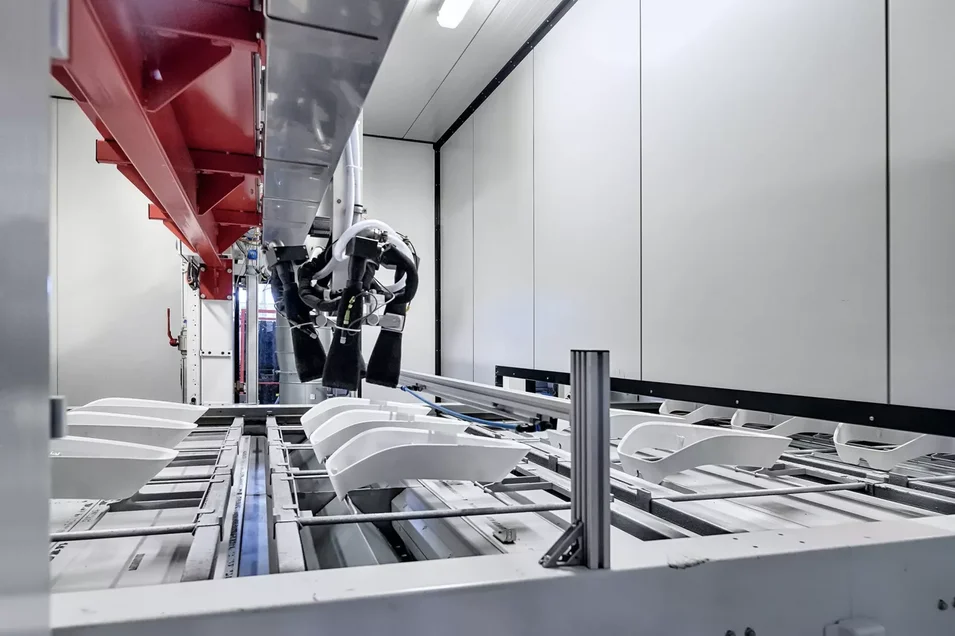
At the infeed of the machine, the components lying on specific parts skids are placed in a horizontal position on the transport pallet and later removed at the same point as a finished component. If the workpieces need to be coated on all sides, an optional turning device can be installed.
The conveyor chain of the pallet conveyor travels at a constant speed through all system components. This has been programmed in particular for the flash-off after coating in industrial production so that the desired treatment and holding times are achieved.
The advantage is that space-saving system concepts are possible with this pallet conveyor. On the one hand, this relates to the high dryer, which utilises the space in height instead of spreading out in length. The pallets are conveyed in circulation according to the paternoster principle.
2. Pre-treatment of the components
The upstream pre-treatment removes contamination from the workpiece surfaces using liquidCO2. This is followed by high-performance dedusting/ionisation with consumption-optimised, rotating blow-off nozzles. The whirled up particles are removed via an efficient extraction system. Cleaning is followed by neutralisation of the static surface charge of the workpieces via an ionisation system. The workpieces leave the pre-cleaning process in a clean and charge-neutral state.
4. Spray painting
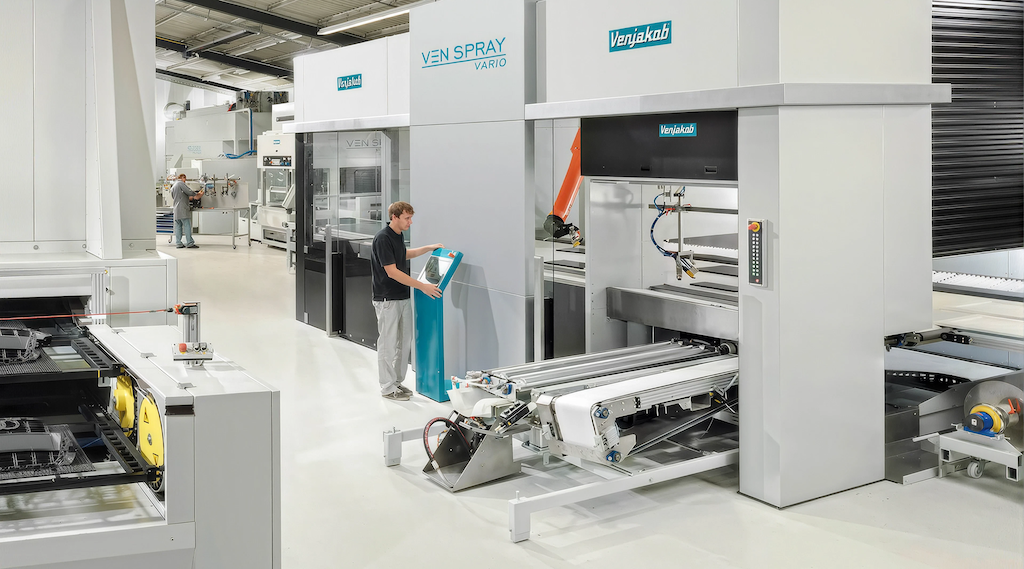
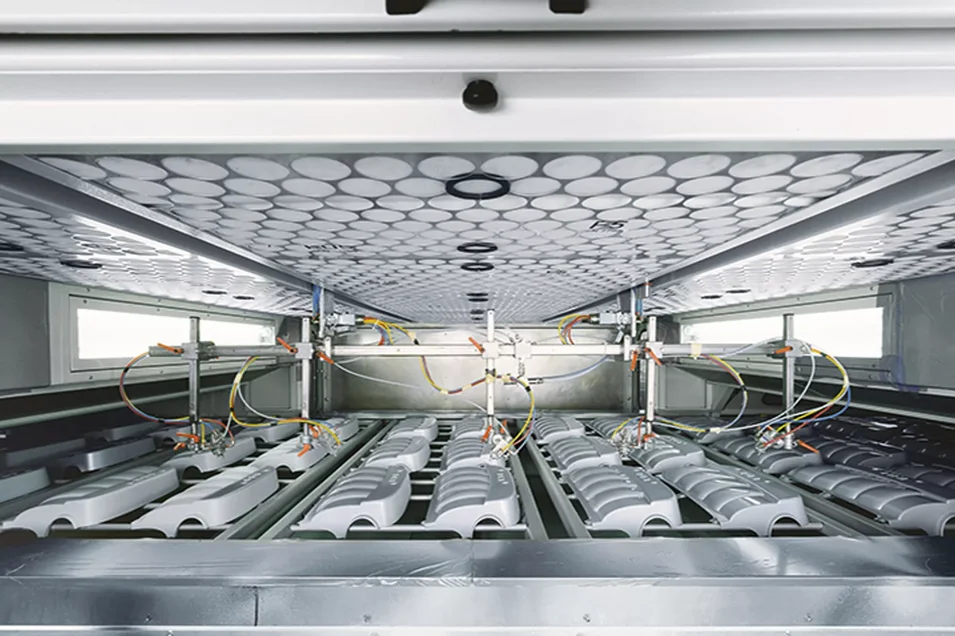
The coating lines convey the components on a parts carrier under the spray guns, which move at right angles to the direction of travel. Industrial finishing is carried out in a continuous process without stopping. The machine can be equipped with an automatic colour change system. The colour change takes place automatically in conjunction with the higher-level system control.
The supply lines between the system and the spray guns have been kept short to avoid unnecessary paint loss during rinsing. The Venjakob colour management system also ensures shorter set-up times and lower solvent consumption.
An application-adapted extraction system, in conjunction with a sophisticated fresh air supply, enables the overspray produced to be optimally removed. The workpieces are recorded on the infeed side using a workpiece scanner and the machine control system creates a consumption-optimised spray painting programme for each spray gun installed.
5. Drying process
The length of the subsequent flash-off zone is designed for the painting process and the associated painting speed. It is also possible to integrate infrared drying into the evaporation zone. Downstream UV drying using a robot that moves at right angles to the conveying direction is also an option. The downstream circulating air dryer is designed on six levels and is easily accessible for cleaning and maintenance purposes thanks to movable dryer elements. The drying time and associated size (length) of the dryer is adapted to the painting process. There is a cooling zone below the system. This is where the components are conveyed back to the inlet of the coating lines. optimum flash-off after coating in industrial production, drying , hardening or cooling are important process steps when it comes to achieving a high surface quality.
6. Fresh air supply
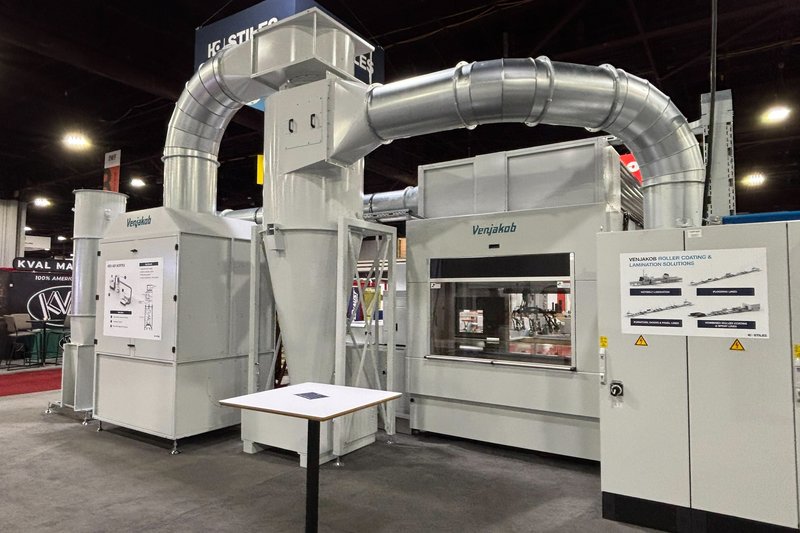
Fresh air is supplied independently of the hall. The supply air systems draw in the air from outside, filter, heat and humidify it in accordance with the climatic conditions of the coating systems to be processed. At some locations and when using different coating systems, full air conditioning of the supply air is a prerequisite in order to keep the climatic conditions for industrial finishing constant all year round. Full air conditioning can be integrated into the supply air system at any time.
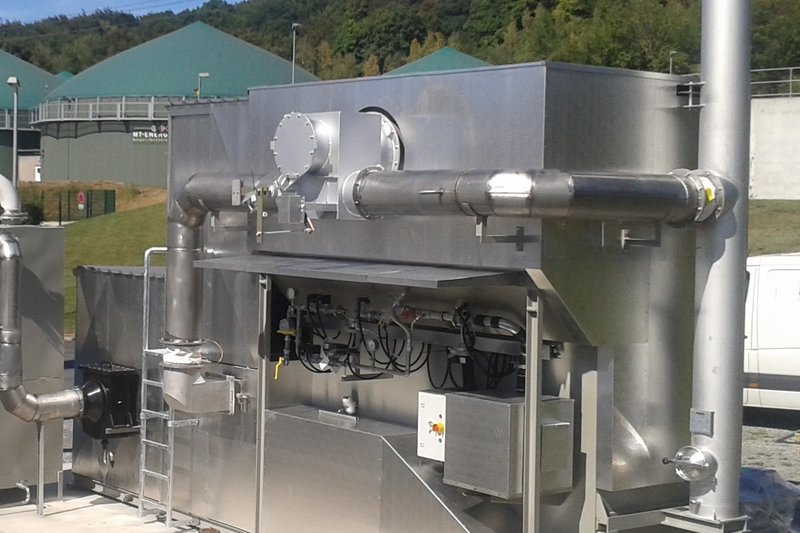
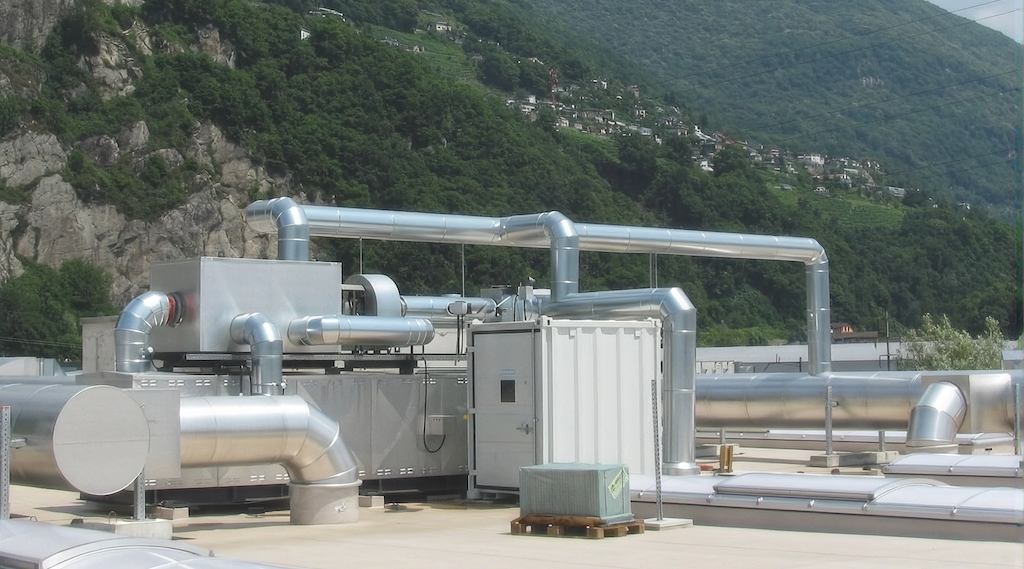
7. Exhaust air purification
The removal of organic solvents from the exhaust air of the entire system is ensured by exhaust air purification technology from Venjakob Umwelttechnik. This is customised and designed to suit the solvent consumption and the exhaust air volume. A wide variety of technologies such as RNV and TNV are used here, if necessary in conjunction with a concentration rotor. In this way, the strict limit values of the international air treatment guidelines, such as the European VOC, can be complied with.