

Curtain coating and dipping for precise surfaces
Curtain coating and industrial dipping are among the coating technologies that enable complete wetting of the workpiece surfaces. In curtain coating, the component is flooded by a defined media flow, while industrial dipping is achieved by complete immersion in a coating medium. Both processes are suitable for low-viscosity systems and offer a reliable coating, even for complex geometries. We can advise you on when curtain coating or industrial dipping is the right solution for your application.
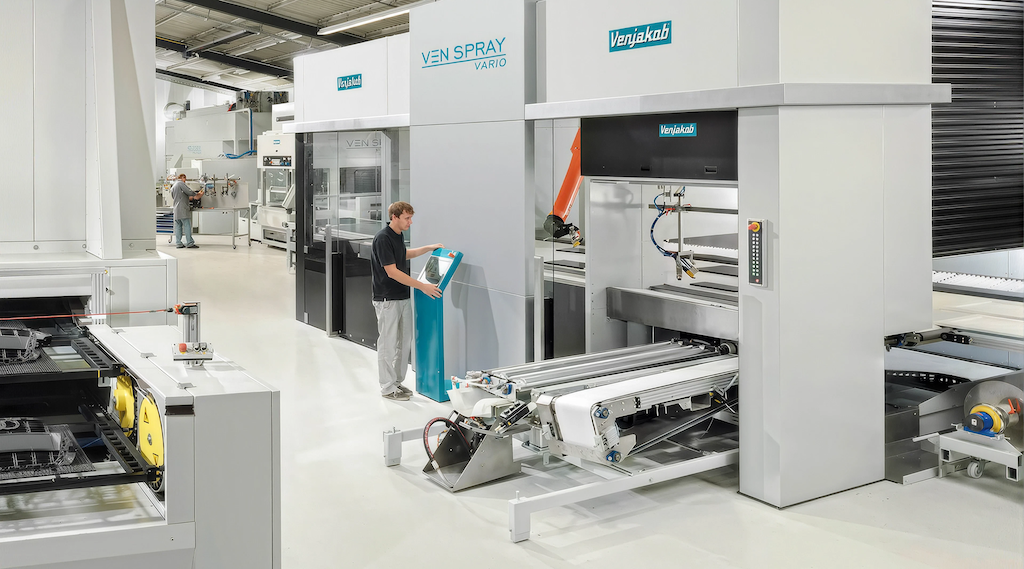
VEN FLOW curtain coating systems from Venjakob
Our VEN FLOW curtain coating systems work in a surplus flood process and achieve uniform coatings in a continuous process. Profile parts, panels and components are completely wetted, while excess medium drains off in a controlled manner and is recirculated in a closed circuit. The curtain coating systems are suitable for hydrophobic coatings, glazes and low-viscosity primers and can be flexibly integrated into industrial production lines thanks to their modular design.
Explore curtain coating systems


Media and coating systems in the curtain coating process
The curtain coating and industrial dipping systems are designed for low-viscosity and low-viscosity coating media that enable uniform flow patterns and clean edges.
- Thin film primers
- Glazes for wood and wood-based materials
- Hydrophobic coatings for façade elements
- Water-based and low-solvent systems
- Functional protective coatings


How does curtain coating work?
In curtain coating, a defined media flow flows completely over the workpiece. Excess material runs off in a controlled manner, is filtered and reused in a closed circuit. The process is designed for linear and profiled components and supports stable, reproducible coating patterns - even at high line speeds.
How does industrial dipping work?
Industrial dipping is carried out by completely immersing the workpiece in a coating medium. This means that even areas that are difficult to access can be reliably wetted. It is suitable for low-viscosity systems and components that need to be coated all around, including concealed geometries.
When does curtain coating or industrial dipping make sense?
Curtain coating is particularly suitable for continuous line processes and workpieces that can be easily transported in flood lines. Industrial dipping is the preferred method when internal structures or geometries that need to be completely wetted have to be taken into account. The decisive factors are component orientation, the required all-round coverage and the available material volume.
Which parameters influence the coating quality in curtain coating and industrial dipping?
The coating quality is determined by several process-related factors, including the viscosity of the medium, temperature, flow rate, wetting behaviour of the substrate and dripping time. In curtain coating, the media flow height and flow control also have an effect. In industrial dipping, the dipping speed, holding time and dripping angle influence the result. Precise process control is crucial for reproducible coating results.
How do different workpiece geometries affect the choice of processes?
Linear and profiled components benefit from curtain coating, as the media flow favours even wetting. Components with internal geometries, milled recesses or cavities often require industrial dipping, as even concealed structures can only be reliably reached through complete immersion. The decision is made on the basis of geometric complexity, component orientation and the desired all-round coverage.


We are happy to advise you
Would you like to find out more about our systems, processes or solutions - or do you already have a specific project in mind? Our contacts are on hand to provide you with expert advice, technical expertise and many years of experience.

Gert große Deters
Business Unit Manager for General Industry & Automotive
Telephone: +49 5242 9603-184E-mail: ed.bokajnev@sretedessorg.treg

Christian Streit
Head of Wood | Building Materials Division
Telephone: +49 5242 9603-162E-mail: ed.bokajnev@tierts.naitsirhc


