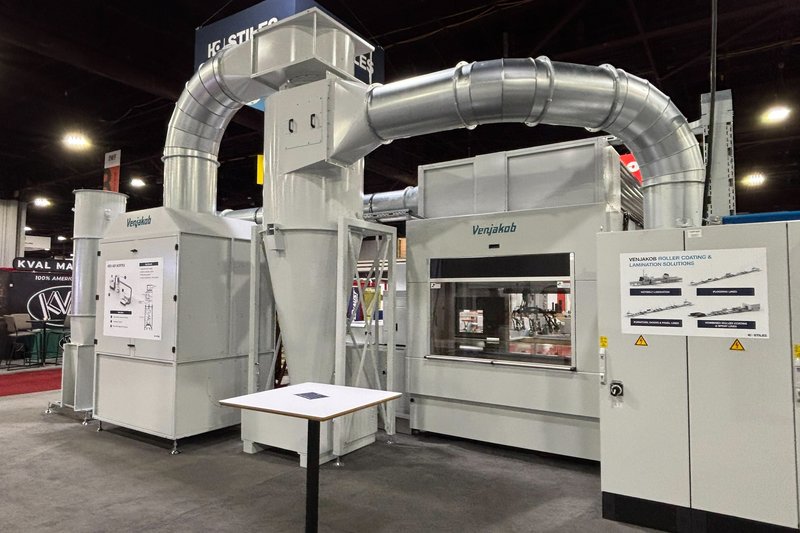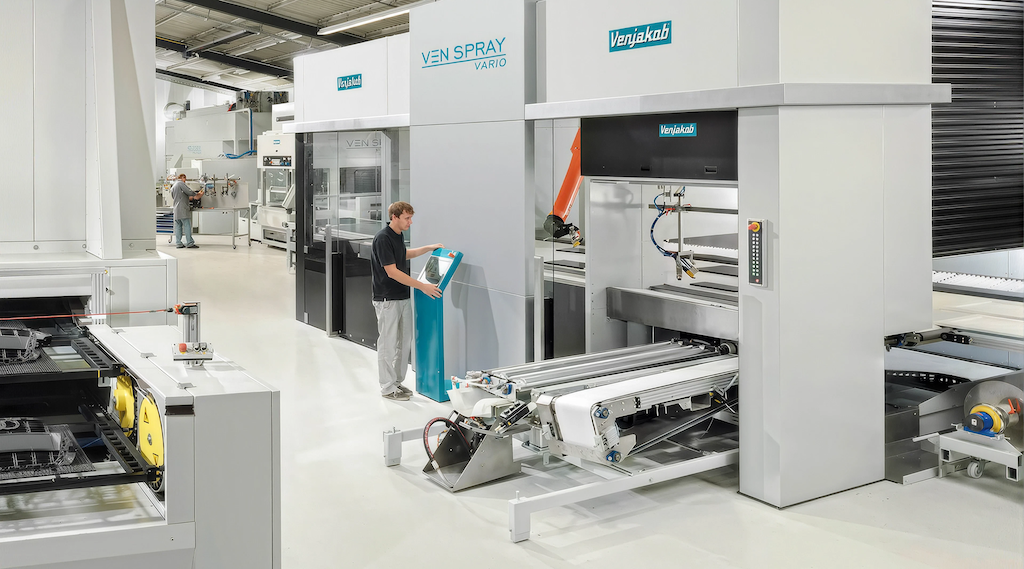
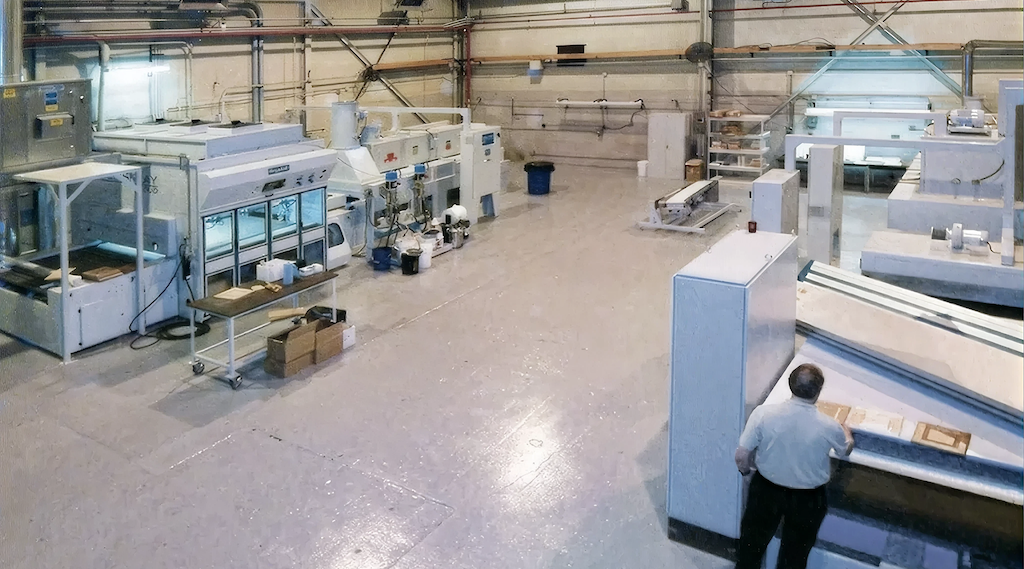

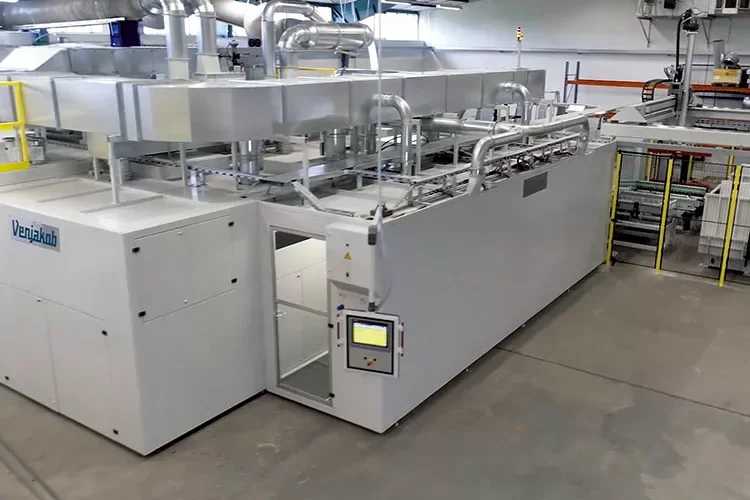
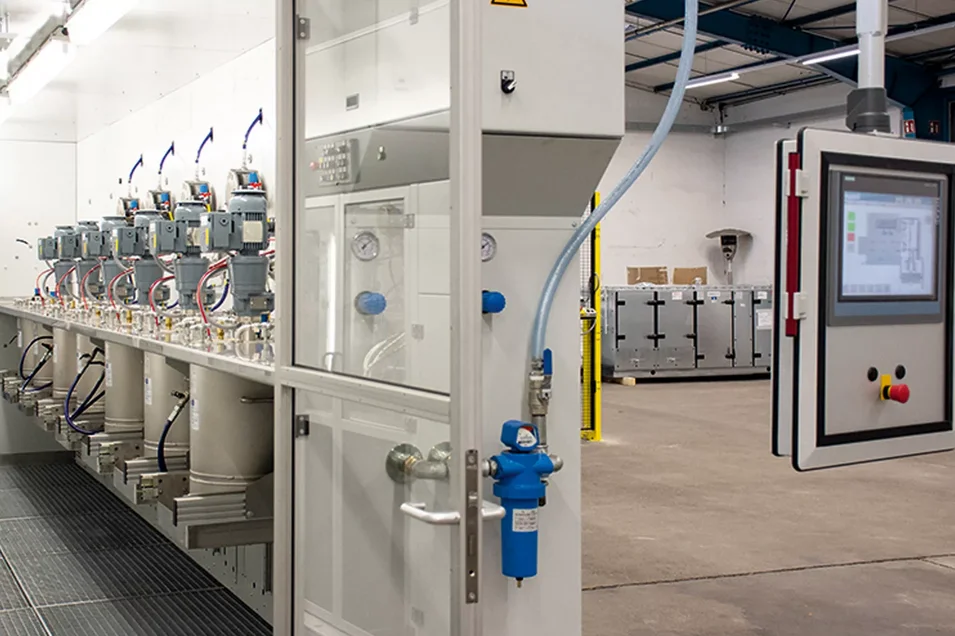
The company OMK Vyksa in Russia is one of the largest manufacturers of pipeliner pipes in the world. Previously, Vyksa had bought in some of the pipe sockets required to manufacture its pipes. In order to produce faster and more flexibly and to be able to offer the complete product range from a single source, Vyksa set up a modern production line for the manufacture of pipe sockets. The two fully automatic coating lines for industrial finishing, marking and labelling of pipe sockets fit seamlessly into the newly built production hall, which covers an area of 15.8 x 29 metres. The complete production process for pipe sockets can therefore take place in one production hall. "When planning the new system technology, it was important for us to integrate all manufacturing processes in one hall. Short distances for maximum efficiency. The engineers from Venjakob fulfilled this important criterion with this compact system," says Dimitriev Alexander Mikhailovich, Project Manager at OMK Vyksa.
The right programme for every type of socket
The pipe sockets produced in-house are not only intended for the company's own use, but are also sold to companies that do not have their own socket production facilities. "This requires a certain degree of flexibility in the painting line. On the one hand, the workpiece carriers had to be designed in such a way that they could accommodate different sizes of sockets. Secondly, the automated marking and signature process had to take into account different standard specifications and the possibility of individualisation," says Kornelius Berg, Sales Engineer at Venjakob Maschinenbau, describing the challenge.
The colouring of the casing surface and the ring marking as well as the marking of the socket comply with the applicable API and GOST standards. To ensure that the system can be set up quickly and easily for different joints, the Venjakob team created a separate programme menu for each joint type. This is stored in the control system and can therefore be easily called up by the machine operator. For customised markings, the machine operator has an easily accessible keyboard panel directly on the marking system (jet system), where he can enter the required data for the next batch of sockets himself.
Coating in a matter of seconds
The entire coating process - from loading at the loading station through the individual processing stations to removal - takes place completely without external intervention. The conveyor systems used for the fully automatic material handling, including the process monitoring, were planned, developed, built and installed by Venjakob at Vyksa. The system is designed for a wide range of pipe socket types. Round pipe sockets with an outer diameter of 73 mm to a maximum of 450 mm, a length of 100 mm to a maximum of 330 mm and a weight of 2.34 kg to 47 kg can be processed. The capacity of the system is related to the diameter and length of the sockets. The maximum output is 225 sleeves per hour, which corresponds to a cycle time of 16 seconds per sleeve. With the largest socket type, the output would be 60 sockets per hour, which corresponds to a cycle time of 60 seconds per socket. The average cycle time for a socket with a diameter of 300 mm and a length of 250 mm is 25 seconds.
The process
Loading and placing on workpiece carriers
In the first step, the pipe sleeves are automatically arranged in several layers on top of each other in a container. The sockets are removed from the container in rows, placed on the turning station and then positioned vertically. They are then transported to the loading portal via a chain transport system. From here, the pipe sockets are placed individually on the workpiece carriers. These can be infinitely adjusted to the desired size of the pipe sleeves - the spindle holders are closer or further together.
Industrial finishing, marking and labelling process with preparation of the sleeves
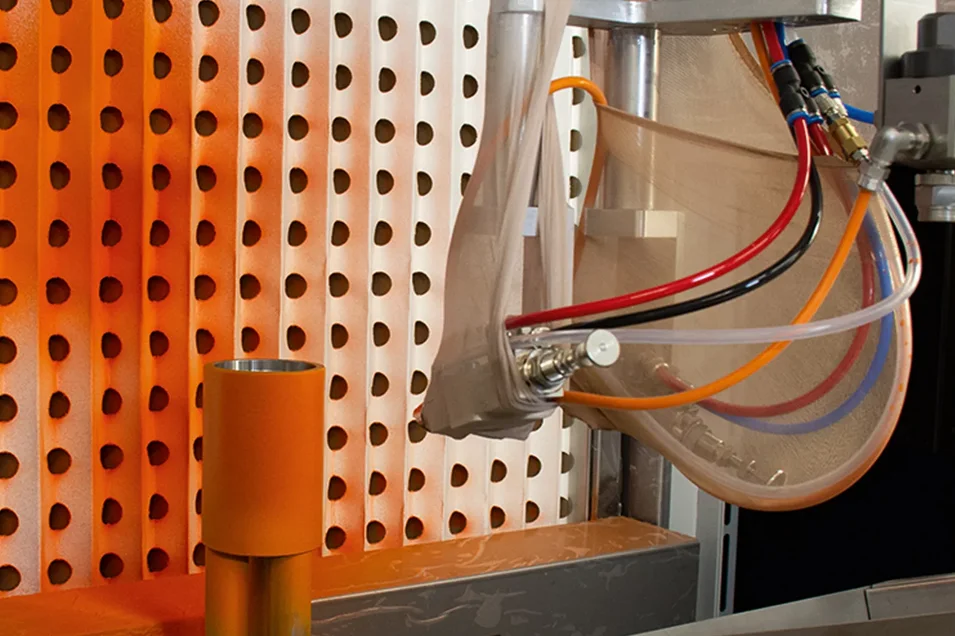
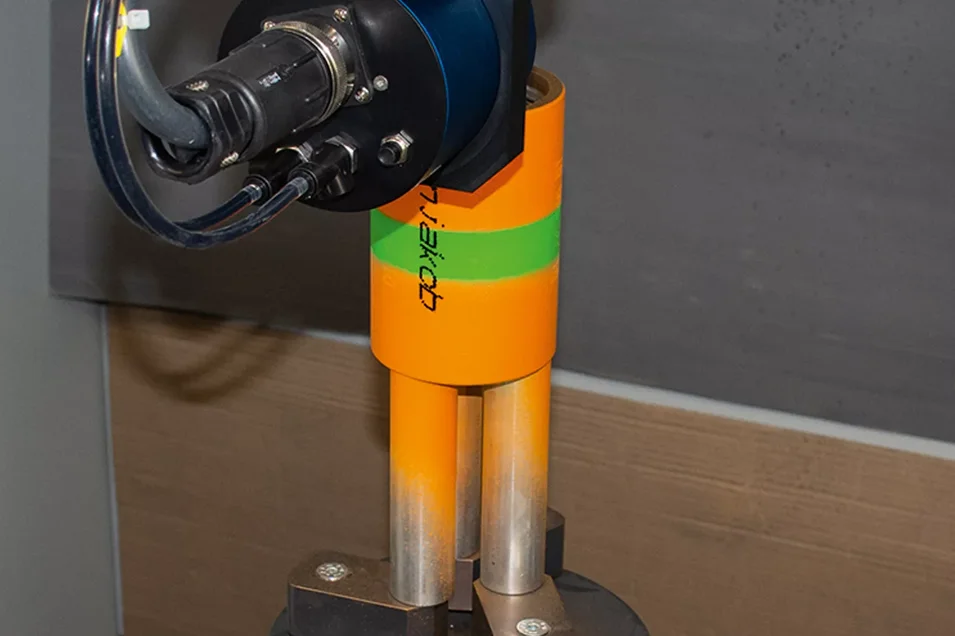
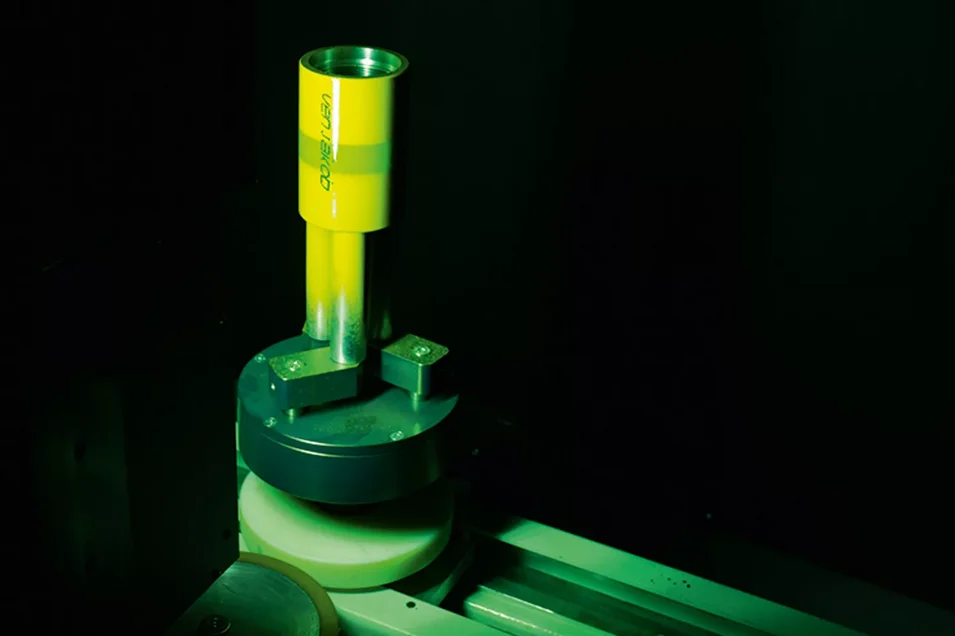
Preheating, external and internal coating and hot air drying take place in closed systems on a spindle chain conveyor. During preheating, the temperature is raised to between 10 °C and 15 °C. The shell is then coated with a solvent-based paint. A total of 11 colours are available, which are applied using spray guns. The sleeves pass through a drying section and are spray-painted again for the ring strip marking. Each colour has a different meaning here, which is defined in the corresponding API or GOST standard. After drying again, the sleeves enter the jet system for labelling the outer surface. The labelling in black or white can be entered individually via a keyboard panel. After a further drying phase, a UV clear coat is applied to protect the signature for transport. The clear coat is cured using a UV lamp.
Internal thread is protected against corrosion
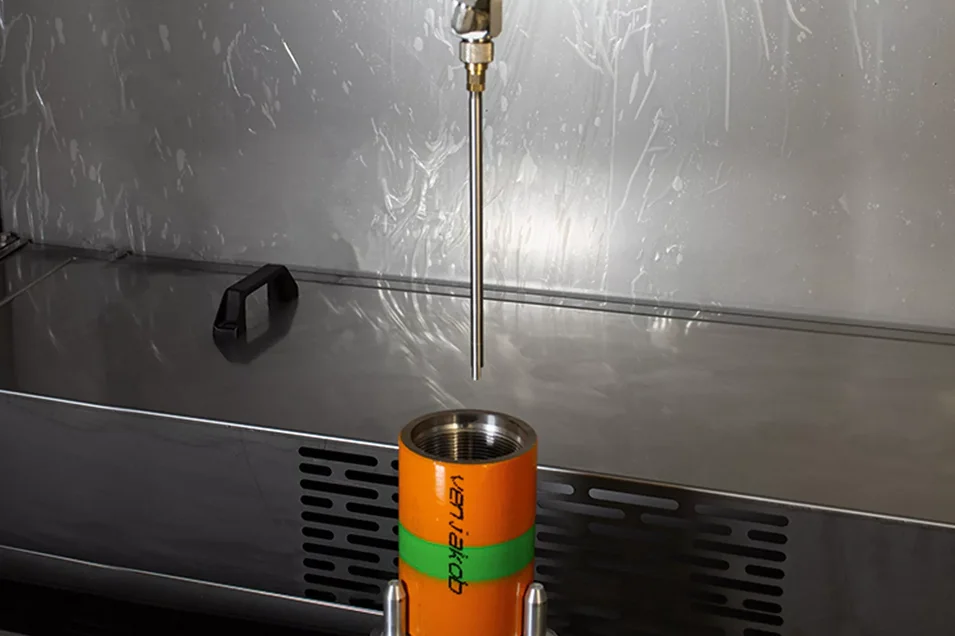
Once the external coating has been completed, the pipe sleeves are placed on the workpiece carriers for the internal coating. Here, the sockets are transferred to another spindle chain conveyor for the internal coating. Thread preservation with an oil-water emulsion is also carried out in a closed system.
Removal and loading directly next to each other
After subsequent hot air drying, the finished pipe sleeves are placed on the outfeed conveyor belt and fed to the turning station for collection. In the final step, the turned sockets are placed in rows - using a magnetic gripper portal - in several layers in the removal container.
Special features of the pipe socket coating lines at a glance
- Fully automated material handling
- Flexible design for different pipe socket types
- Customised marking and labelling options - in accordance with standard specifications
- UV clear lacquer coating for corrosion and protective coating of the casing surface
- Thread preservation with oil-water emulsion
- Thread coating as corrosion and anti-friction coating
- Fast throughput of the pipe sockets
- Seamless integration into the entire manufacturing process
- Compact, modular design