
Flexible and economical painting technology for the furniture industry
Future-proof coating lines are characterised by their cost-effectiveness and maximum flexibility thanks to the use of intelligent control and digitalised communication systems. Venjakob's modular concept also allows the individual machines to be equipped as required and upgraded with additional functions at any time.
Surface treatment in industrial furniture production is an important, possibly even the most important part of the entire production chain. A lot of money can be spent here, but just as much can be saved. Expensive paints, time-consuming machine cleaning, compliance with environmental regulations and constantly changing trends in materials and coats require technical equipment that offers the user the required flexibility and thus investment security over the years.
Overall concept with individual solutions
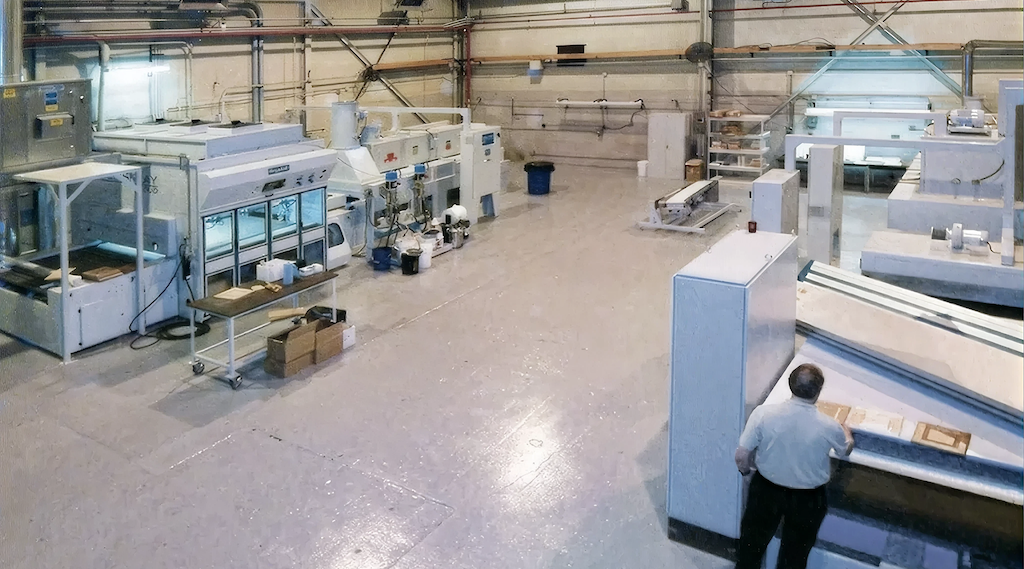
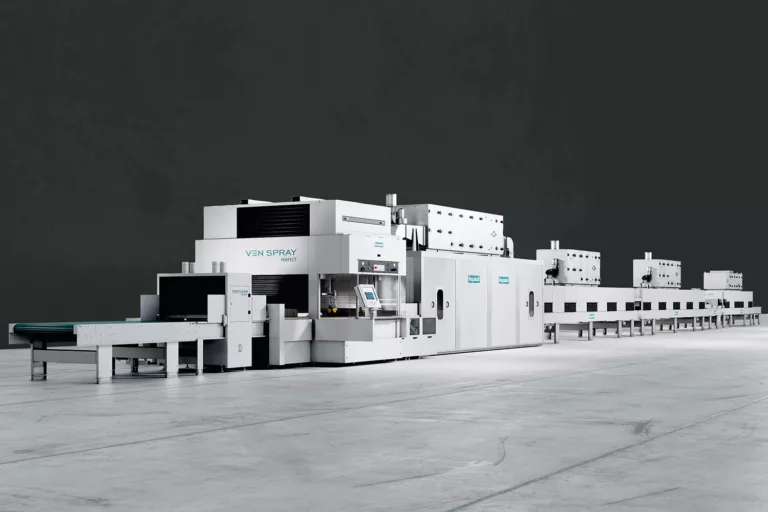
The overall system concept for surface treatment described here serves as an example of what modern coating lines are capable of. The Venjakob system was customised to the production process for coating furniture surfaces, glass surfaces and special materials. The individual machines - from the preparation of the workpieces to spray painting and drying - were equipped with optimised individual equipment and combined to form a complete system.
Traditional water-based or organic solvent-based wood coats as well as UV coats can be used. For coating glass surfaces, the common
2-component polyurethane systems or enamel paints can be used in the system.
Central control panel for all machines
All relevant system parameters are available via the system's internal communication system (Ethernet) and can be preselected and set via a central control panel. This enables flexible interaction between all individual components. Each product is given its own recipe. Each colour can be prepared in parallel to ongoing production and activated within a very short time.
High system availability
With regard to the amortisation of the system investment, Venjakob focused on the highest possible variability in the use of the machines when planning the production line presented here. The technical equipment was selected accordingly. In particular, the spray painting process was focussed on. Typical for industrial spray coating is the division of the total production time into production and cleaning. This determines how efficiently and profitably the system works. The advantages of the modular design are therefore particularly evident in the spray coating lines. For example, the user has the option of configuring his machine in such a way that non-stop operation is possible without interrupting cleaning. Important "time robbers", such as cleaning the belt cleaning systems, can thus take place in parallel with production.
Indispensable: machine and process data
Important information about the processes, the productivity of the system and characteristic data documenting wear are indispensable for consistent production quality, logistical planning and system maintenance. The advantages of process data acquisition include
- Maintenance is informed of necessary wear work by means of the characteristic data before the plant has to be stopped due to a breakdown.
- Production management receives reliable data on productivity and can therefore meet the specified targets.
- Material flows and resource planning are easier within the networked information network, as requirements are recognised at an early stage.
- The entire supply and discharge logistics can be planned flexibly as productivity is known.
The surface treatment in 3 steps
1. Cleaning: Preparing the workpieces
The upstream workpiece cleaning frees the workpiece surfaces from contamination without contact using consumption-optimised, rotating blow-off nozzles. The whirled up particles are fed into the on-site dust extraction system via an efficient extraction system. The cleaning process is followed by neutralisation of the static surface charge of the workpieces via an ionising system. The workpieces leave the pre-cleaning process in a clean and charge-neutral condition.
2. Spray painting: fully automated colour change
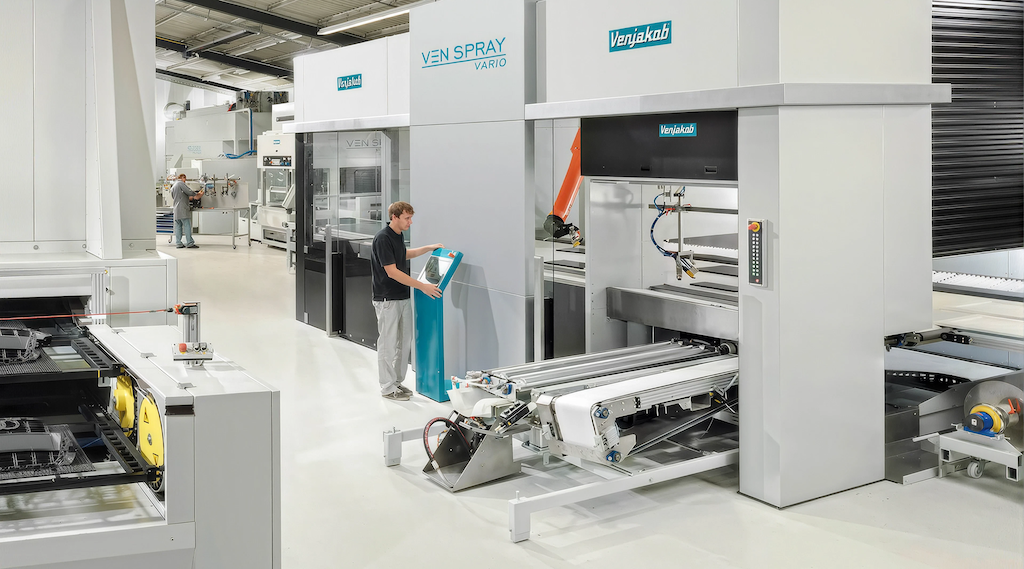
The spraying machine conveys the workpieces via a closed belt conveyor system under the spray guns, which move at right angles to the direction of travel. The machine is equipped with an automatic colour change system. In conjunction with the higher-level system control, the colour change takes place automatically. An application-adapted extraction system, together with a sophisticated fresh air supply, enables optimum removal of the overspray produced. The workpieces are recorded on the infeed side using a workpiece scanner and the machine control system creates a consumption-optimised spray painting programme for each spray gun installed. The remaining coat, which collects in the offset area of the workpiece edges on the conveyor belt, is recovered and cleaned using a patented belt cleaning system. The cleaning system is designed so that different water-based and solvent-based coating systems can be freely alternated in the system. Alternatively, non-stop production can be set up, which provides external cleaning of the belt cleaners during ongoing production. Due to its modularity, the machine is equipped with a high level of production availability, which can be achieved by installing a second washer. The highest energy and environmental standards are met.
3. Drying system: Freely configurable
The drying system consists of modules that can be freely configured in terms of the process-related variables of air speed, temperature and optionally also humidity. The usual drying phases adapt to the coating systems used. Everything is possible: from short evaporation phases to intensive drying phases, supported by infrared heat radiation with final UV curing. The final cooling by means of a controlled, conditioned cooling process leads to a reproducible and reliable overall drying process.